It is the question that comes up most often before a flight: where do we take off from, and what will we see up there? The answer fits in one sentence: we choose the launch site to take you over Lake Annecy, or at the very least to give you the finest view of it. And since the wind is in charge, that launch site is only decided at the last moment. Here is how it works in practice.
In short: Lake Annecy is always the target of the flight. The pilot waits for the final weather bulletin at 6 pm the day before, works out the prevailing wind for the morning, then calls you back with the actual meeting point: we launch from one side of the lake or the other depending on wind direction, so the balloon drifts over the water. On the programme: the lake, its châteaux and the surrounding massifs — Semnoz, La Tournette, the Aravis — with Mont Blanc on the horizon on a clear day.
Contents
The launch site is chosen to put you over the lake
A hot air balloon is not flown like an aeroplane: it has no engine and no rudder. It drifts with the air mass, and the pilot plays with altitude to catch layers of wind that do not all travel in quite the same direction. In other words, the wind decides the track — we do not.
That does not mean we launch at random. Quite the opposite: precisely because the balloon cannot be steered, we pick the launch point according to the forecast wind, specifically in order to reach the lake. If the prevailing flow comes from one side, we set off from the opposite shore so as to drift over the water. The reasoning runs backwards from the destination: we start from where we want to end up — Lake Annecy — and deduce where we must lift off.
This is why the meeting point cannot be announced at the time of booking. The pilot waits for the last weather bulletin, the 6 pm one the evening before the flight: it is the most reliable for the following morning. From it he reads the prevailing wind direction, settles on the launch point, then calls you straight away to give you the actual take-off location and the exact time.
So the same flight may depart from one side of the lake one morning and from the other side the following week — for the same intended result: flying over the lake, or a track that gives you the best possible view of it. Just plan to have transport to the meeting point: travel to the launch site is not included.
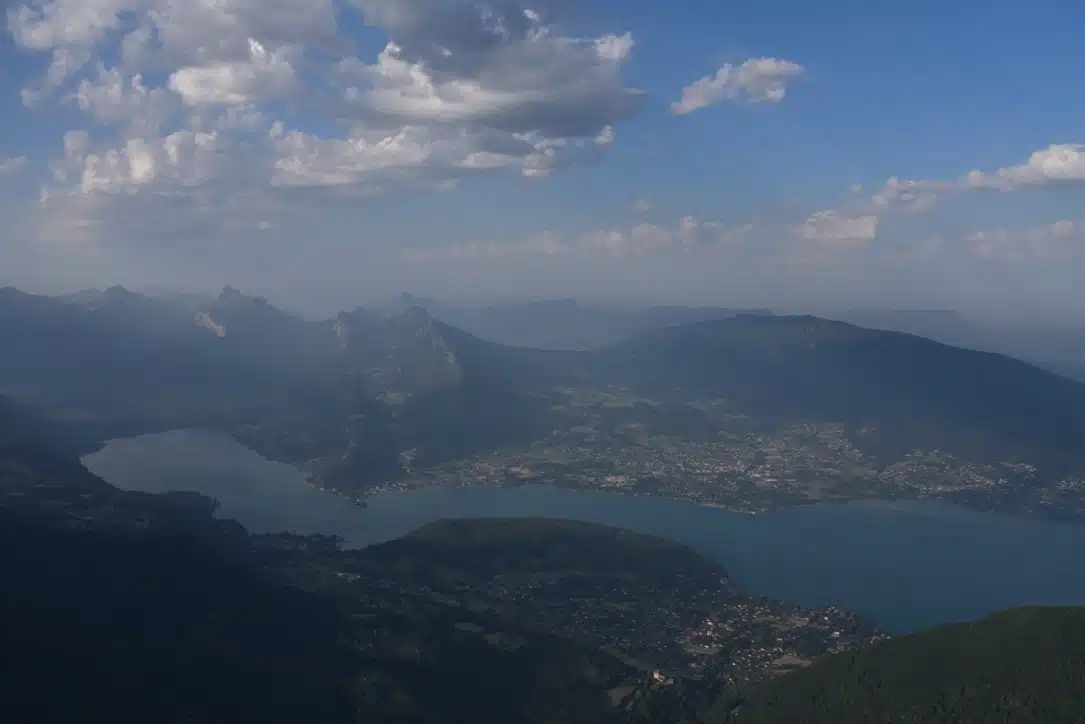
Lake Annecy seen from above
It is the star of the flight, and it never disappoints. At dawn, before the boats come out, the surface is perfectly smooth: the sky and the mountains are mirrored in it. The colour shifts with depth, from the turquoise of the shallows to the deep blue of the middle of the lake.
Depending on the track, several landmarks stand out clearly:
- The château de Menthon-Saint-Bernard, perched on its spur above the eastern shore — one of the finest sights of the whole flight.
- The Roc de Chère peninsula, the wooded headland that separates the main lake from the small lake.
- The château de Duingt and its isthmus, opposite, on the western shore.
- The villages of Talloires, Veyrier, Saint-Jorioz or Sévrier, depending on which way the wind takes us.
- The southern end of the lake and its reed beds, a protected nature reserve far better appreciated from the air than from the ground.
What the wind changes is not whether the lake is on the programme — it is the angle from which you discover it. Some mornings we skim one shore just above the water; others we cross from shore to shore; others again we gain height over the hillsides and the whole lake unfolds in a single panorama, from the southern end all the way to Annecy. Three flights, three different postcards — which is exactly why no two flights are ever alike.
The mountains: La Tournette, the Semnoz, the Aravis and Mont Blanc
The lake is framed by two very recognisable landforms: La Tournette (2,351 m) to the east, with its massive silhouette and its summit « armchair », and the Semnoz to the west, a long wooded ridge overlooking Annecy.
Behind them stretches the Aravis range, the limestone barrier running from La Clusaz to Le Grand-Bornand. And on a clear day — frequent in autumn and winter — the Mont Blanc massif appears on the eastern horizon: white, immense, some sixty kilometres away.
The particular sensation of ballooning is to take all of this in in silence, with no wind on your face, since the balloon travels at the speed of the air itself. Only the burner punctuates the flight, a few seconds every two or three minutes.
And where does it land?
Nothing is decided in advance there either. Towards the end of the flight, the pilot spots a suitable field from the air: open ground, no sensitive crops, reachable by road for the recovery vehicle. He then works his descent to set down gently.
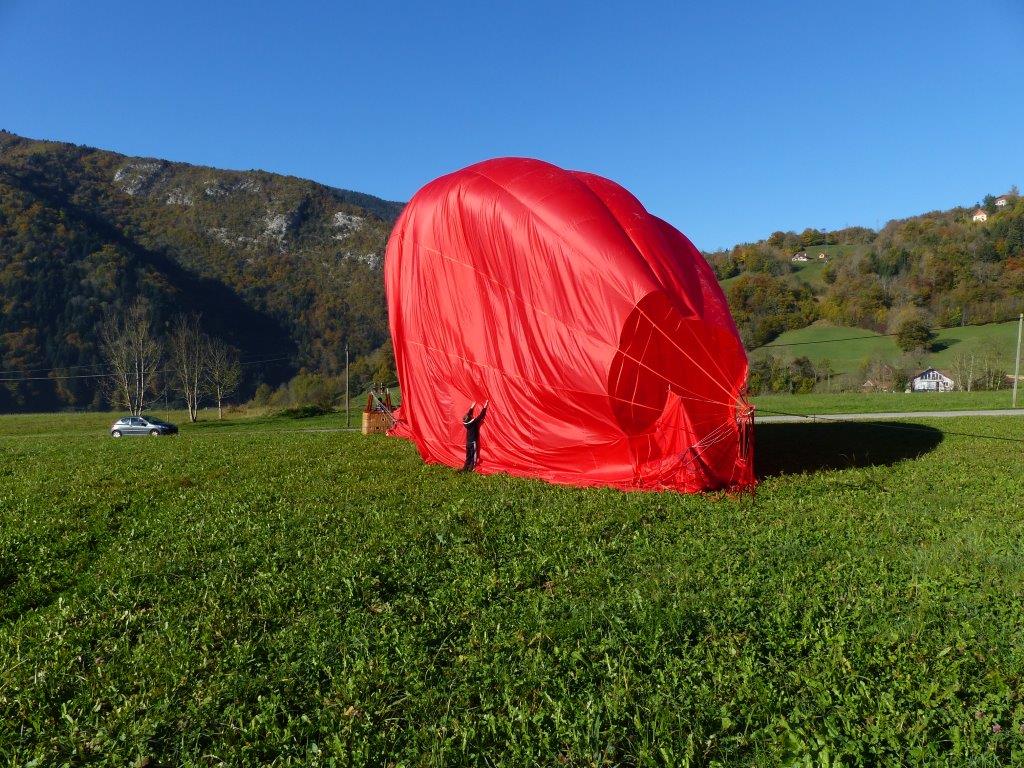
So when you climb into the basket you do not know where you will come back down — and that is precisely part of the charm. A ground crew follows the balloon by vehicle throughout the flight and joins you at the landing site. You help pack the envelope away (it is sociable, and surprisingly quick with several pairs of hands), and then comes the aeronaut’s toast: champagne and cookies, a tradition inherited from the very first flights of the 18th century.
You are then driven back to the starting point. That is why you should allow about 3 hours in total for 45 minutes to 1 hour 15 of flying.
Getting good photos from the basket
A few simple tips that make all the difference:
- Keep the strap around your wrist. A phone dropped from 300 metres is not coming back. That is rule number one.
- Shoot early. The finest light is in the first twenty minutes, while the sun is still low and shadows stretch the relief.
- Do not only look at the horizon. The best images are often straight down: rooftops, fields, the shadow of the balloon on the mist.
- Put the camera away for the landing. Your hands need to be free to hold the basket handles.
Frequently asked questions
Where does the hot air balloon take off from in Annecy?
The launch site is not fixed: it is chosen according to the forecast prevailing wind, so that the balloon drifts over Lake Annecy. The pilot waits for the final 6 pm weather bulletin the evening before the flight, then calls you back with the actual take-off location and the exact time. Depending on wind direction, we launch from one side of the lake or the other. Travel to the launch site is not included.
Do you really fly over Lake Annecy?
That is the aim of every flight: the launch point is chosen precisely so the balloon drifts over the lake, or failing that to offer the best possible view of it. What the wind changes is the angle — we skim one shore, cross over, or gain height to take in the whole lake at once.
Where does the balloon land?
In a field chosen by the pilot at the end of the flight, according to the track flown and the ground available. A crew follows the balloon by vehicle throughout the flight and picks you up at the landing site to drive you back to the starting point.
What altitude do you fly at?
Altitude varies throughout the flight: the pilot climbs and descends to find the wind layers he wants. You may skim the treetops at one moment and gain several hundred metres a few minutes later, opening up the view over the massifs.
Can you choose the flight path?
No. A balloon moves with the air mass: the pilot steers by changing altitude to catch different winds, but he does not choose his destination. That is the very nature of ballooning — and the reason no two flights are ever the same.
Want to see it for yourself?
Hot air balloon flights over Lake Annecy and the Aravis range, from €310 per person.
Postponed free of charge if the weather does not allow take-off.
Read next: which season to fly in · frequently asked questions · contact us.