Hot air balloon flights run all year round in Annecy — but not at any hour, and not in any weather. Take-off happens at sunrise, when the air is at its calmest, and every season offers a completely different view over the lake. Here is how to choose your morning.
In short: flights take place at sunrise, all year round, weather permitting. The most reliable and most photogenic period is autumn (September to November): calm air, morning mist drifting over the lake, golden forests and the first snow on the Aravis range. Summer means the earliest starts (meeting around 5.30–6 am), winter the clearest views of Mont Blanc. A flight lasts 45 minutes to 1 hour 15, for about 3 hours on site, from €310 per person.
Contents
Why do balloon flights take place at sunrise?
It is not about the light — it is about the air. A hot air balloon has no engine and no rudder: it drifts with the air mass. It therefore needs air that is calm and stable.
As soon as the sun warms the ground, that ground sends bubbles of warm air upwards: these are thermals, the very same ones paraglider pilots look for. Excellent for a wing, very uncomfortable for a balloon — they make steering imprecise and landings tricky.
The only two windows when the atmosphere settles down are the first hour after sunrise and, more rarely, the last hour before sunset. Around Lake Annecy, hemmed in between the Semnoz and the Aravis, the morning is by far the more reliable of the two — which is why all our flights are scheduled at dawn.
Season by season: when to fly over Lake Annecy
Spring (March – May): washed air and snow-capped peaks
This is the season of contrasts. The Aravis range and the Mont Blanc massif are still largely under snow while the meadows of the Glières plateau and the orchards below turn green again. Just after a weather front has passed through, the air is remarkably clear and the lake takes on the emerald colour it is famous for.
Meeting time is around 6.30 am in March, moving earlier as the season advances. The trade-off: spring is also the most unsettled period, with more weather postponements than in autumn. Keep your dates flexible.
Summer (June – August): the very early flight
In June and July the sun rises before 6 am, so the meeting time is usually around 5.30–6 am. That is early — but it is also the most magical moment of the day over the lake: the water is a mirror, the beaches are deserted and Annecy is still asleep.
Summer has another advantage: the mildness at take-off, which matters when you are standing still in the basket. On the other hand, hot days generate late-afternoon thunderstorms and strong valley breezes that close the flying window quickly. We take off, we enjoy it, and we are back on the ground before the mountain wakes up.
Autumn (September – November): the finest time to fly
If you only get to pick one season, pick this one. Autumn high-pressure systems settle the air for several days in a row: flying windows are more frequent and far more reliable than in spring.
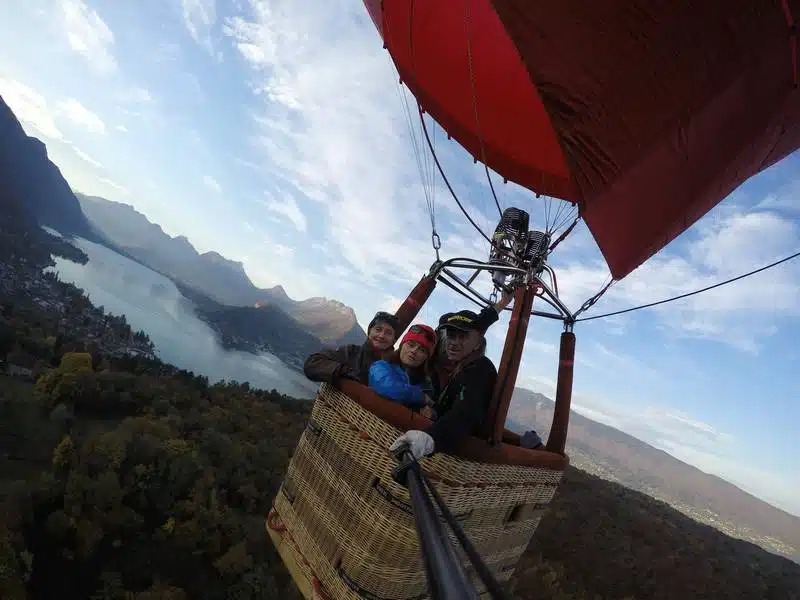
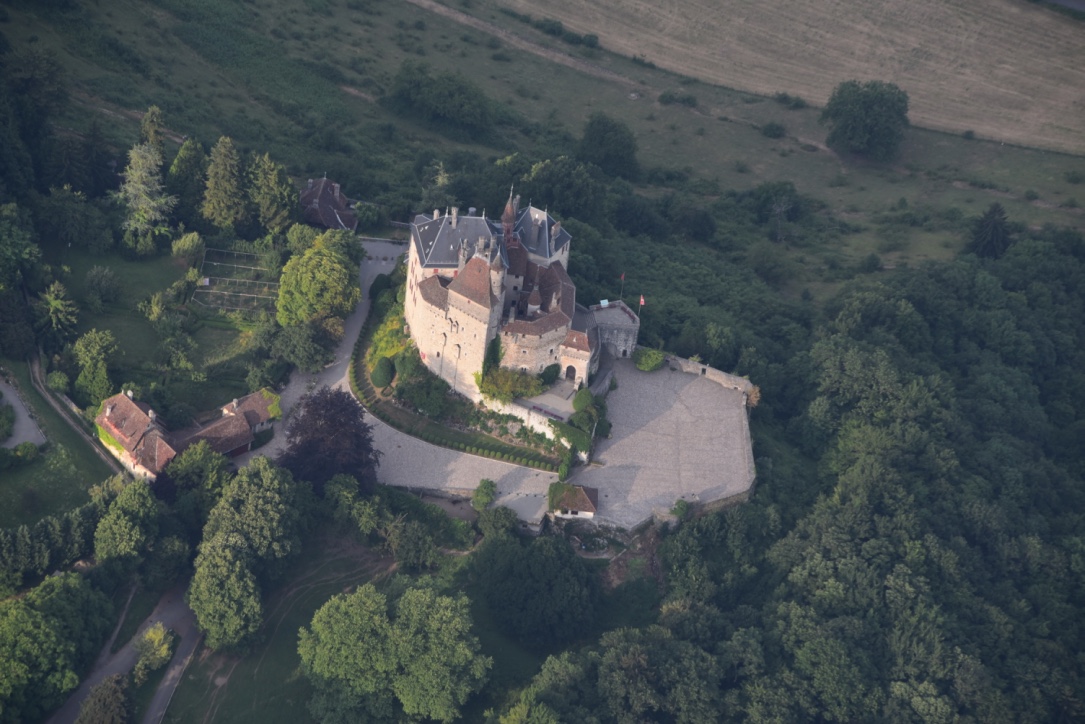
Above all, this is the season of morning mist. The lake, still warm, releases a low blanket of fog at dawn from which the château de Menthon, the Roc de Chère and the village bell towers emerge. You take off above that sea of cloud, with the russet Aravis and the first snow-dusted summits behind. It is the scene everyone comes for — and the meeting time, around 7–7.30 am, is far more comfortable than in midsummer.
Winter (December – February): the clearest air of all
Many passengers do not realise it: we fly in winter too, and visibility is often exceptional. Cold, dry air clears the horizon like no other season — Mont Blanc looks close enough to touch, La Tournette and the Semnoz are white, and the landscape is silent.
Meeting time is the latest of the year (around 8–8.30 am) and, inside the basket, it feels milder than on the ground thanks to the burner right above your heads. You simply need to wrap up properly for the inflation and pack-up phases, on the ground. This is also the gift voucher season: given at Christmas, the flight can be booked at leisure the following spring.
At a glance
| Season | Typical meeting time | What you see | Good to know |
|---|---|---|---|
| Spring Mar – May |
6 – 6.30 am | Snowy summits, green valleys, transparent air | Most unsettled season: keep flexible dates |
| Summer Jun – Aug |
5.30 – 6 am | Mirror-like lake, empty beaches, golden light | Very early start; short flying window (afternoon storms) |
| Autumn Sep – Nov ★ recommended |
7 – 7.30 am | Mist over the lake, russet forests, first snow | Most stable conditions of the year; book early |
| Winter Dec – Feb |
8 – 8.30 am | Clear Mont Blanc, snowy scenery, crisp air | Wrap up for the inflation; gift voucher season |
Meeting times are indicative: the exact time is confirmed by the pilot the day before the flight, based on sunrise and the weather forecast.
What weather do we need to take off?
Three factors drive the decision, and one person makes it: the pilot, in command of the aircraft.
- Wind. The number one criterion. A balloon takes off in light, steady wind with no gusts. Beyond that, inflation becomes difficult and the landing too fast.
- Rain. We do not fly in the rain: water weighs the envelope down and damages the fabric.
- Visibility. Thick fog at ground level prevents take-off — not to be confused with the thin autumn mist, which we fly above and which makes the flight so beautiful.
If conditions are not right on the day, your flight is postponed free of charge to a later date. You lose neither your flight nor your money. That is the rule of the game in ballooning: better a postponement than a mediocre flight.
How far in advance should you book?
Two things overlap here. On one side, availability: autumn weekends and summer mornings fill up fast, so allow several weeks for those slots. On the other, the weather, which can only be forecast seriously three or four days ahead.
The right approach is therefore to book well in advance to secure your place, knowing the date may shift by a few days if the sky decides otherwise. If you are visiting Annecy for a short stay, schedule your flight early in the trip so you keep spare days.
Worth knowing for a birthday or a proposal: choosing a hot air balloon gift voucher rather than a fixed date avoids any disappointment, since the recipient picks their own slot.
What should you wear?
There is no relative wind in the basket: the balloon travels at the speed of the air mass, so you feel no draught at all, and the burner spreads a pleasant warmth overhead. It is often milder in the air than on the ground.
The real cold is the waiting and the inflation, in the dew-soaked grass at dawn. The rule is the same in every season: closed shoes, trainers ideally (the grass is wet), trousers, several layers you can shed once airborne, and a hat or cap. Avoid dresses, heels and loose scarves.
Which flight suits your plan?
- First time, with family or friends → the shared-basket flight, from €310 per person: see all our hot air balloon flights in Haute-Savoie.
- Just the two of you, for a special occasion → the Love Flight, with a private basket for two — the ideal setting for a proposal.
- Small group or company event → private charter and corporate formats on our corporate hot air balloon page.
- Still deciding → the frequently asked questions cover the practical details.
Frequently asked questions
What is the best season for a hot air balloon flight in Annecy?
Autumn, from September to November. High-pressure conditions are the most stable of the year, morning mist over the lake creates spectacular scenery, and the meeting time (7–7.30 am) remains comfortable. Spring and winter also produce beautiful flights, with maximum visibility over Mont Blanc in winter.
Can you fly in a hot air balloon in winter in Annecy?
Yes. Flights operate all year round whenever the weather allows. The cold, dry winter air actually offers the best visibility over the Mont Blanc massif. Inside the basket, the heat from the burner keeps the temperature very bearable; you mainly need warm clothes for the inflation on the ground.
What time does a hot air balloon take off in Annecy?
At sunrise, with a meeting time ranging from 5.30 am in midsummer to 8.30 am in winter. This is when the air is calmest, before the sun-warmed ground creates turbulence. The exact time is confirmed by the pilot the day before the flight.
What happens if the weather prevents the flight?
The flight is postponed free of charge to a later date of your choice. Only the pilot decides whether to fly, based on wind, precipitation and visibility. Nothing is lost.
How long does a hot air balloon flight last?
The flight itself lasts 45 minutes to 1 hour 15, depending on conditions. Including the welcome, inflation, flight, pack-up and the traditional aeronaut’s toast, allow about 3 hours on site.
How far in advance should I book?
Allow several weeks for autumn weekends and summer mornings, which are the most sought-after slots. As the weather is only reliable three or four days ahead, book early for the place and stay flexible on the exact date.
Ready to pick your morning?
Hot air balloon flights over Lake Annecy and the Aravis range, from €310 per person.
Postponed free of charge if the weather does not allow take-off.
A question about a specific date or season? Get in touch or read the hot air balloon FAQ.